S Corp vs. Sole Proprietor: Are You Saving on Taxes Today but Sacrificing Social Security Tomorrow?
 Certified CFO
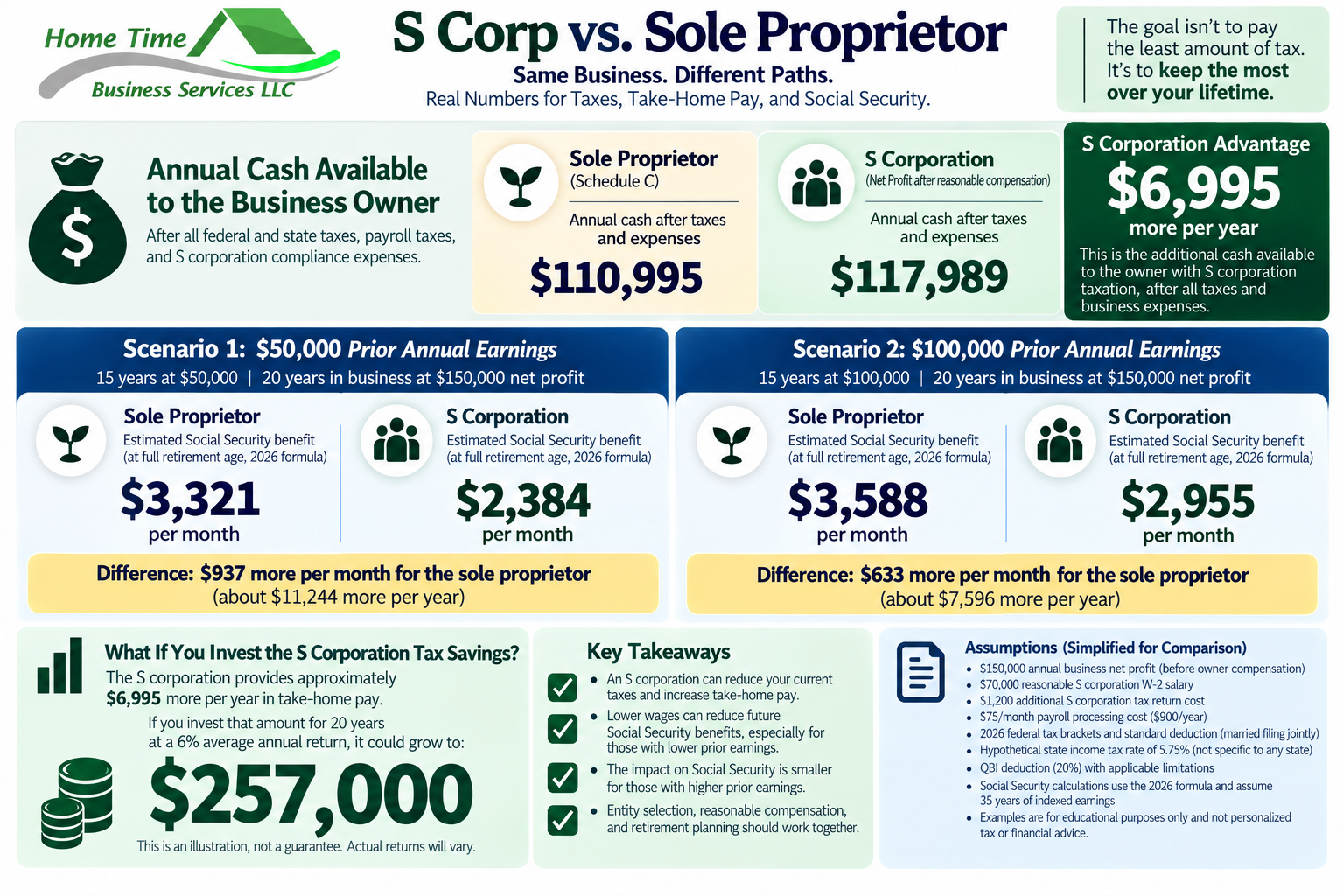
Why choosing the right business tax structure involves more than minimizing this year's tax bill.
When business owners ask whether they should elect S corporation status, the conversation usually begins with one question: "How much money will I save in taxes?"
It's a reasonable question. An S corporation may reduce Social Security and Medicare taxes. But there's another question that deserves attention: "What could those tax savings cost me in retirement benefits?"
The same strategy that reduces payroll taxes today may also reduce your future Social Security benefits. Let's compare two business owners with identical businesses but different earnings histories.
First, How Does Social Security Calculate Your Retirement Benefits?
Social Security generally uses your highest 35 years of covered earnings, adjusted for national wage levels. For someone first eligible in 2026, the retirement benefit formula applies 90% to the first $1,286 in average indexed monthly earnings, 32% to earnings between $1,286 and $7,749, and 15% above $7,749. These are benefit-formula percentages, not percentages of your paycheck paid in retirement.
As lifetime earnings rise, each additional dollar generally adds less to the eventual monthly benefit. Previous employment history therefore matters when evaluating a business tax election.
Source: SSA — Primary Insurance Amount formula
How Sole Proprietors and S Corporation Owners Build Social Security Benefits
Sole proprietors
Qualifying net earnings from self-employment generally count toward a sole proprietor's Social Security earnings record. A sole proprietor with $150,000 in net business profit would generally have about $138,525 in covered self-employment earnings after the standard 92.35% adjustment, subject to applicable wage-base and other rules.
S corporation owners
An S corporation shareholder who works in the business generally must receive reasonable W-2 compensation. Those wages count toward Social Security. The shareholder's share of pass-through net profit generally does not count as covered Social Security earnings.
Importantly, S corporation shareholders generally pay income tax on their allocated pass-through net profit whether or not the corporation distributes that profit. Net profit is the business's earnings after expenses; a distribution is a transfer of cash or property to the shareholder. They are not interchangeable terms.
Sources: IRS — S Corporations · IRS — S Corporation Compensation and Medical Insurance Issues
Same Business. Same Profits. Different Retirement Outcomes.
Assume both owners operate businesses earning $150,000 annually before owner compensation. Under an S corporation election, each receives $70,000 of assumed reasonable W-2 wages. Each has 15 years of prior indexed earnings and 20 subsequent years in business.
Scenario 1: $50,000 in prior annual indexed earnings
| Structure | Estimated monthly benefit |
|---|---|
| Sole proprietor | $3,321 |
| S corporation | $2,384 |
| Difference | $937 more for sole proprietor |
That is approximately $11,244 more annually for the sole proprietor. Across 20 years of retirement, the nominal difference would total $224,880 before considering inflation adjustments, taxation, survivor effects, or other changes.
Scenario 2: $100,000 in prior annual indexed earnings
| Structure | Estimated monthly benefit |
|---|---|
| Sole proprietor | $3,588 |
| S corporation | $2,955 |
| Difference | $633 more for sole proprietor |
That is approximately $7,596 more annually for the sole proprietor. The gap is smaller because more of the owner's average indexed earnings falls in the 15% portion of the benefit formula.
These Social Security amounts are simplified illustrations using the 2026 benefit formula and assumed indexed earnings—not forecasts of actual benefits payable 20 years from now.
What About the Tax Savings?
Using 2026 federal married-filing-jointly assumptions, a hypothetical 5.75% state income tax on federal adjusted gross income, applicable QBI deduction limitations, $1,200 in annual additional S corporation tax-return costs, and $75 per month in payroll processing costs:
| Annual cash available after taxes and expenses | Amount |
|---|---|
| Sole proprietor | $110,995 |
| S corporation | $117,989 |
| S corporation advantage | Approximately $6,995 |
S corporation pass-through net profit is generally still subject to income tax. The potential payroll-tax savings arise because reasonable W-2 wages are subject to employment taxes while pass-through net profit generally is not. Federal income tax, QBI limitations, and compliance expenses all affect the bottom line.
Source: IRS — Form 8995 instructions (QBI deduction)
What If You Invested the Tax Savings?
Investing approximately $6,995 at the end of each year for 20 years at an assumed 6% annual return would accumulate to roughly $257,000. That is a potentially meaningful retirement asset, but investment returns are not guaranteed.
Social Security and investment accounts serve different purposes. Social Security generally offers inflation-adjusted lifetime retirement income, as well as potential disability and survivor protections. Investment assets offer flexibility and may be left to heirs. If annual tax savings are spent rather than invested, an owner could reach retirement with lower Social Security benefits and no offsetting investment assets.
Reasonable Compensation Isn't Optional
A working S corporation shareholder generally must be paid reasonable compensation for services performed before receiving non-wage distributions. The amount depends on duties, time devoted to the business, experience, qualifications, and comparable pay—not on a desired tax outcome. The $70,000 wage in this article is an illustrative assumption, not a recommended wage for every business.
Source: IRS — S Corporation Employees, Shareholders and Corporate Officers
Don't Forget Other Retirement Savings Opportunities
Entity structure and compensation also affect certain retirement-plan contribution calculations. For an S corporation shareholder-employee, contributions generally depend on eligible W-2 compensation rather than pass-through profit. For sole proprietors, contributions generally depend on adjusted net self-employment earnings, subject to plan limits and other rules.
Source: IRS — Retirement Plan FAQs regarding contributions: S corporation
So, Should You Stay a Sole Proprietor or Elect S Corporation Status?
There is no universal answer. A business owner's profitability, reasonable compensation, previous covered earnings, retirement timeline, other savings, household situation, and goals all matter. The lowest tax bill is not necessarily the best lifetime financial outcome.
Tax Planning Should Look Beyond April 15
At Home Time Business Services, we believe tax planning should accomplish more than minimizing what you owe this year. We help business owners understand pass-through net profit, reasonable compensation, and the long-term consequences of their decisions—so money remains a tool for greater control, freedom, and time.
Considering an S corporation election or revisiting your current compensation strategy? Schedule a Right Fit Call.
Disclaimer: Educational illustration only; not individualized tax, legal, investment, or Social Security advice. Figures assume simplified 2026 rules and no other income, credits, or itemized deductions. The 5.75% state tax is hypothetical, not Arkansas's rate. Actual taxes, Social Security benefits, and investment outcomes will differ.
Tags: